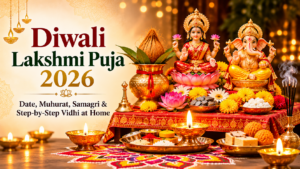
Every year, a few days before Diwali, the same question lands in our WhatsApp inbox: “Pandit ji, what time should we do the puja, and what do we need to buy?” This guide answers both. Do the puja yourself with it, or let one of our pandits handle the vidhi while your family takes part.
When is Diwali Lakshmi Puja in 2026?
Diwali Lakshmi Puja is on Sunday, 8 November 2026, on the night of Kartik Amavasya. Dhanteras comes two days earlier, on Friday 6 November, and Naraka Chaturdashi (Chhoti Diwali) on Saturday 7 November.
The puja is done in the evening, during Pradosh Kaal, the window of roughly two and a half hours after sunset. Many families prefer the part of Pradosh Kaal that overlaps the Vrishabha lagna, a “fixed” ascendant. The belief is that wealth invited during a fixed lagna stays.
In most Indian cities the Lakshmi Puja muhurat falls between about 6:00 pm and 8:45 pm. Exact minutes depend on your city’s sunset, so check today’s timings on our Panchang or ask your pandit. Shops and offices often hold a separate Chopda or Sharda puja for account books, usually in the afternoon or late evening.
Pradosh Kaal is the sacred window which spans roughly 45 minutes to 1.5 hours before and after sunset and is considered a potent time for worshipping Lord Shiva and Goddess Parvati.
What you need: Lakshmi Puja samagri checklist
Buy these a day or two early. The Diwali-day rush at the flower market is real.
For the altar
- A low wooden chowki and a red or yellow cloth to cover it
- Idols or a framed picture of Lakshmi ji and Ganesh ji (new clay idols are traditional each year)
- A kalash (copper or brass), mango leaves, a coconut with its husk, and a red thread (mauli) to tie around it
- A silver coin or a few coins, plus your account book or a notebook if you run a business
For the puja itself
- Roli (kumkum), haldi, chandan, akshat (unbroken rice)
- Ghee or mustard-oil diyas, cotton wicks, camphor and incense sticks
- Lotus flowers if you can find them, plus marigolds and garlands
- Paan leaves, supari, cloves, cardamom
- Panchamrit: milk, curd, ghee, honey and sugar
- Kheel-batashe, sweets (kaju katli and besan laddoo are favourites) and seasonal fruit
- A small bell and an aarti plate
If you book a pandit through MyPujaSetu, the core puja samagri comes with the pandit. Flowers, fruit, sweets, the chowki and the kalash are usually arranged by the family, and we send a preparation list on WhatsApp after booking.
How to do Lakshmi Puja at home, step by step
- Clean and decorate. Clean the puja corner and the main entrance. Draw a rangoli at the door, and make small footprints with rice paste or kumkum leading inside, as if Lakshmi ji is walking in.
- Set up the chowki. Spread the cloth and make a small heap of rice in the centre. Most families place Ganesh ji on the left and Lakshmi ji on the right as you face them.
- Place the kalash. Fill it with water, add a coin, supari and a little rice. Arrange the mango leaves and set the coconut on top. The kalash goes in front of the idols, slightly to the right.
- Take the sankalp. Hold water, rice and a flower in your right hand. Say your name, gotra, the place and the date, and state that you are doing the puja for the family’s well-being and prosperity. Then release it onto a plate.
- Worship Ganesh ji first. Offer water, roli, akshat, flowers and a sweet, and chant Om Gan Ganapataye Namah. No puja begins without him.
- Lakshmi ji’s puja. Bathe a silver coin or the idol with panchamrit, then clean water. Apply kumkum, offer flowers (lotus if you have one), a red chunri, sweets, kheel-batashe and fruit. Chant Om Shreem Mahalakshmyai Namah 11 or 108 times.
- Honour Kuber and your work. Place your account books, cash box or laptop near the altar, mark them with a swastik in kumkum, and offer a flower. This is the moment to pray for the year’s work.
- Light the diyas. Light the main ghee diya at the altar first, then carry diyas to every room, the kitchen, the tulsi plant and the entrance.
- Aarti. Sing Om Jai Lakshmi Mata with the whole family, then share the prasad.
Traditionally, one diya near the altar is kept burning through the night, and the main door is left slightly open so Lakshmi ji can enter.
Common mistakes we see
- Doing the puja too early. Afternoon puja before sunset misses Pradosh Kaal. Wait for dusk.
- Skipping Ganesh puja. Even in a short puja, Ganesh ji comes first.
- Old, chipped idols. Many families immerse or respectfully put away last year’s clay idols and bring new ones home.
- Leaving the house dark. Put at least one diya at every doorway, not just the altar.
- Rushing the aarti to get to the crackers. The puja is the point. The fireworks can wait 15 minutes.
Do it yourself, or book a pandit?
You can do a simple Lakshmi Puja on your own with the steps above. A pandit is worth it if you want the full shodashopachara (16-step) puja with proper Sanskrit mantras, a business Chopda puja, or simply want the family free to take part instead of reading instructions.
- Book a pandit for Lakshmi Puja at home in Mumbai, Pune, Delhi or Bangalore. Choose Shuddh, Sampoorna or Maha Vidhi depending on how elaborate you want it, and request a pandit who chants in your language.
- Away from home this Diwali? Join an Online Lakshmi Puja on video, with the sankalp taken in your family’s name.
- For shop or office owners, a Lakshmi Kubera Puja around Dhanteras is a popular addition.
Diwali slots fill up fast, so book at least a week ahead.
FAQs
What is the date of Diwali Lakshmi Puja in 2026?
Sunday, 8 November 2026, on Kartik Amavasya. The puja is done in the evening during Pradosh Kaal.
What is the best time for Lakshmi Puja on Diwali?
Pradosh Kaal, after sunset, ideally while the Vrishabha lagna is rising. In most Indian cities this is between roughly 6:00 and 8:45 pm. Check your city’s exact time on the Panchang.
Can we do Lakshmi Puja without a pandit?
Yes. A simple puja with sankalp, Ganesh puja, Lakshmi puja, diyas and aarti is complete when done with devotion. A pandit adds the full Vedic vidhi and mantras.
Which direction should the Lakshmi idol face?
Ideally the altar is in the north-east of the home, and you sit facing east or north while doing the puja.
Should we keep a diya burning all night?
Many families keep one ghee diya near the altar burning through the night as a sign of welcome. Keep it in a safe spot, away from curtains.