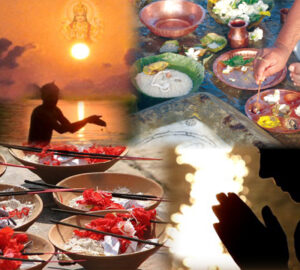
Pitru Paksha 2026 falls between 26th September and 10th October, with Sarva Pitru Amavasya on Saturday, 10th October, also known as Mahalaya Amavasya, being the most important day of the fortnight. Whether you are performing an ancestral ritual at home, at a river ghat or at a tirtha (holy place), such as Gaya or Varanasi, this guide provides you with key information on everything you need to know before undertaking this important task.
What is Pitru Paksha?
Every year, the lunar calendar sets aside fifteen days which are dedicated to offering homage to one’s ancestors, or ‘pitrs’ — Pitru Paksha. It falls in the dark fortnight (Amavasya) of the month of Bhadrapada, following the Ganesh festival season and closing on Amavasya, with the most auspicious date for ancestral offering. Checking the Pitru Paksha dates every year is important because the tithi (a day on the Hindu calendar) on which an ancestor passed away can be slightly different every year on the calendar. Checking the Pitru Paksha 2026 dates also helps determine the day for any one particular family’s ancestral rites.
Why do Hindus perform rituals for ancestors?
The rationale behind Hindu ancestral rites is that one’s ancestors are reliant on their descendants for food and well-being in the afterworld. Performing these rituals is seen by Hindus as a debt (Pitru rin) owed to their ancestors. Avoiding this debt is thought to result in ‘Pitra dosh’, or a problem in the family that may arise from unhappy or unsettled ancestors, hence the importance of ancestral rites for Hindus.
What is Shraddha?
Shraddha is the term for the ceremony that is performed to pay homage to a deceased ancestor, usually conducted by a son or male descendant under a priest’s guidance. In practice, this means cooking a specific meal, offering the food first to crows, cows and Brahmins before the family may eat the meal, and doing this all in the memory of the ancestor. The date this is performed on for a particular family is determined by the tithi in the year on which the ancestor passed away.
Read article: https://mypujasetu.com/shraadh-meaning-dates-rituals-samagri-for-pitru-paksha-2026/
What is Tarpan?
Tarpan is a ritual of water offering to ancestors with sesame seeds, usually performed at a river, pond or even at home using a copper vessel, and specific mantras are recited. It is much more accessible than other parts of the Pitru Paksha observance as most family members can perform it, rather than just the son or eldest descendant, and it is not required to have extensive ritual knowledge to perform it.
What is Pind Daan?
Pind Daan is when rice balls are offered to the departed soul, giving the ancestor’s spirit a body to reside in the afterlife. It is usually performed at specific tirthas known for this rite, such as Gaya. This is regarded as a more elaborate and complete ceremony than a regular shraddha performed at home.
What is Narayan Bali?
This rite is performed for restless souls — usually those who died unnaturally, or there was a conflict in the family that prevented their last rites from being performed properly at the time of death. This is usually performed before the shraddha rituals begin, as it is traditional for a restless ancestor to not receive offerings properly until this is complete.
What is Tripindi Shraddha?
When a family believes that three generations of ancestors (or one specific ancestor) are unsatisfied and rituals do not seem to help, a more elaborate ceremony called Tripindi Shraddha is often recommended by a priest or astrologer. This is an elaborate remedy for recurring problems and is thought to take a full day to be performed properly under Vedic guidance.
What is the difference between Shraddha and Pind Daan?
Shraddha is the umbrella term for all the feeding rituals, offerings, and prayers performed on an ancestor’s appropriate tithi, usually at home, with Pindaan being a specific rite of offering rice-ball pindas to give the ancestor’s spirit a body in the afterlife. Every Pindaan sits within a Shraddha observance, but not all Shraddhas require a Pindaan.
Who should perform Pitru rituals?
By tradition, it is the eldest son or a male descendant who should perform the Pitru rituals, but this has been changing for some time. If there is no son, a daughter, grandson, nephew, or a family priest can also perform them in the family’s stead. Particularly, daughters are taking on this responsibility more in smaller nuclear families.
What if the father has passed away?
The son usually performs shraddha and tarpan on the tithi on which the father passed away, which will fall in the fortnight each year. Some families choose to avoid separate rituals for the mother until she has also passed, but this is more regional.
What if the mother has passed away?
Her Shraddha is generally performed on Navami tithi (Matri Navami) — about a week and a half into the fortnight — and many families consider this to be one of the major days of the whole time, meant for remembering mothers and married women in the family.
What if both parents have passed away?
Most families hold the rituals for both parents separately — the father on his tithi and the mother on Matri Navami — but many also choose to perform a combined ritual on the closing Pitru Paksh amavasya, which covers every ancestor, known or unknown, making it useful when tracing the dates of Pitru Paksh for each particular relative is not always practical.
Can an NRI perform Pitru Puja?
Yes, it is quite common, with NRIs either visiting India for the time or arranging for a verified priest to perform the rituals on their behalf, usually at a tirtha such as Gaya or Varanasi, but able to video conference if possible. Many families abroad make sure to consult the Pitru Paksha 2026 calendar and book the priest well in advance because they tend to be booked up quickly near the time of the fortnight.
Can a son perform it on behalf of his parents?
Yes, it is the traditional expectation to do so rather than avoid it. A son performs shraddha, tarpan and related rites for his deceased parents and any other ancestors, and can also authorise a priest to perform the rituals in his name, with his sankalp, or intention, said at the beginning to validate the ritual.
What happens if you don’t know the exact death date?
Not knowing the exact date is not a problem as much as it seems. The ritual can simply be performed on the final Pitru Paksha amavasya, the day dedicated to ancestors whose date has been lost or forgotten, which is also one of the most widely observed days of the whole time.
Can Pitru Puja be performed after Pitru Paksha?
While the fortnight is the most auspicious time, it is not too late to arrange for a Tripindi Shraddha, Narayan Bali or corrective puja at a later point in the year (usually on an Amavasya day or during the month of Magh) — usually on a priest’s advice, and in particular if the delay is due to a suspected pitra dosh which only became apparent after the Pitru Paksha 2026 window had already passed.
Which temples are traditionally associated with Pitru rituals?
Gaya in Bihar, home to the Vishnupad Temple, is the most renowned site for Pind Daan. Varanasi and Prayagraj on the banks of the Ganga see heavy use for tarpan and shraddha, and Trimbakeshwar near Nashik is famous for Narayan Bali and Tripindi Shraddha. Rameswaram, Haridwar and Siddhpur in Gujarat also have long-standing traditions of their own, each with their own regional customs and considerations of timing and procedure.
Whatever the ritual your family chooses, ensuring the correct Pitru Paksha 2026 dates and tithi are followed is more important than the scale of the ritual — a simple and correctly timed tarpan holds as much weight as an elaborate one done on an incorrect day.